


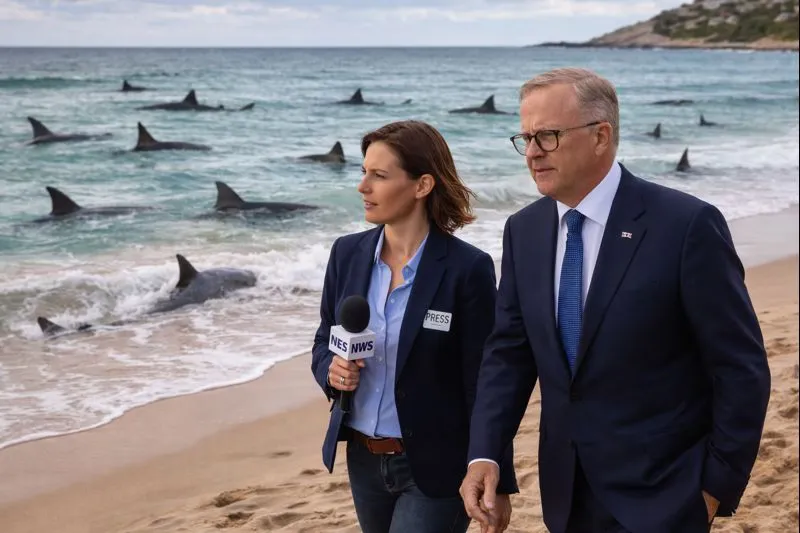
Well, what did the government think was going to happen when they protected sharks? Actually, let me guess. They thought that if we stopped killing sharks, the sharks would stop killing us, simply out of gratitude.
It’s not such an unusual premise. The government’s mass immigration policy is based on a similar delusion: millions of Third World peasants will be so grateful to us for having flung open our borders that they will resist the temptation to scam the NDIS for billions of dollars and forget how much they want to murder Jews.
It’s easy for leftists to implement these fanciful ideological policies because they never suffer the consequences when the inevitable disaster ensues. Just as the architects of our suicidal immigration program live in secure homes in white neighbourhoods, so too do the people who advocate the loudest for the protection of sharks seldom dip their toes in the water. They get all the moral vanity they crave, for none of the cost.
Even today, after four attacks in less than two days, there is little sign that there will ever be a change of heart in government, let alone in the mainstream media or the scientific research departments whose existence relies on perpetuating the myth that sharks are both scarce and essential to the marine environment’s delicate balance, which in turn enables them to extort tens of millions of dollars from the government for “mitigation strategies”.
Watch the explosive documentary, The Heart of Sharkness, here.
The Sydney Morning Herald was quick this morning to rush out a piece explaining to its readers why they keep getting attacked. It’s not the abundance of sharks, of course, but the weather. And the murkiness of the water. And sharks’ poor eyesight. And climate change. And human stupidity.
“To reduce the risk of a shark bite, people should swim, dive or surf with other people, stay out of the water with bleeding cuts and avoid swimming in murky water,” the Herald advised. This advice is mere guesswork. Attacks happen in all conditions, and at all times of the day. And the advice to swim with other people doesn’t reduce the number of attacks per se, it just reduces your chance of being the poor bastard selected at random by the stupid shark. The subtext of this useless advice is always the same, though: if you get bitten, it’s your fault.
But it’s not. Ask any fisherman and they will tell you, shark numbers are out of control. The only people arguing to the contrary are those whose scientific career relies on saying so, which is then repeated by the naive communications graduates masquerading as reporters who think that being a stenographer for self-interested “experts” will somehow save the world from ecological collapse.
The shark species most likely involved in the recent attacks is the bull shark, according to various reports. These animals are like the rats of the sea, able to survive in both fresh and salt water. They are also cunning, opportunistic and aggressive, according to fishermen I’ve talked to. Unlike great whites (which cause most of the attacks in Australia), bull sharks aren’t protected, but they do benefit from the zeitgeist, in which sharks have become the pagan gods of the ocean. State governments have steadily reduced the size of shark fisheries around our enormous coast, which is why there are more attacks at beaches and less flake in fish shops.
In previous times, Opposition politicians analysed our society’s various problems and offered alternative solutions to the ones being implemented by the government. These days, however, both sides of politics instead agree to not offer any solutions at all.
“Drone surveillance is the most cost-effective method of patrolling our beaches from the sky,” said the state Liberal Party’s Brendan Moylan. “If the flags are up, drones should be up.” Moylan knows what he’s talking about. He is, after all, the Liberal spokesman for agriculture, and his rural electorate in the north of the state is a mere 70km from the coast at the nearest point.
Whoever briefed him on this devilish conundrum, though, neglected to tell him that Manly, being one of Sydney’s most popular beaches, is already part of the state government’s expensive drone surveillance program.
Drones are a fake solution, as anyone who has grown up on the beach knows. For surfers, the best conditions are often murky, with low light. Even on sunny days, a shark is not visible against a rocky ocean floor. And drones can’t fly when winds are strong. When pro surfer Mick Fanning was attacked by a great white live on television in 2015, not one of the three cameras focused on him saw the shark coming. The idea that one drone can patrol a whole beach is a fantasy. But, like the scientists putting their hands out for more and more research funds, surf lifesaving organisations reflexively agree to the new toys because it makes them feel more important.
MORE: Shark experts can rot in hell.
Sadly, the situation is unlikely to change. Just as the death of 15 people at Bondi hasn’t enlightened the government or the Opposition about their wilful blindness regarding Islam, four shark attacks in less than two days will evoke little more than yawns among the politicians in state parliament. Politicians are so removed from their constituents that they can’t even see when the most fundamental aspects of Australian life are being destroyed. It’s enough to make you wonder who they really work for.


