


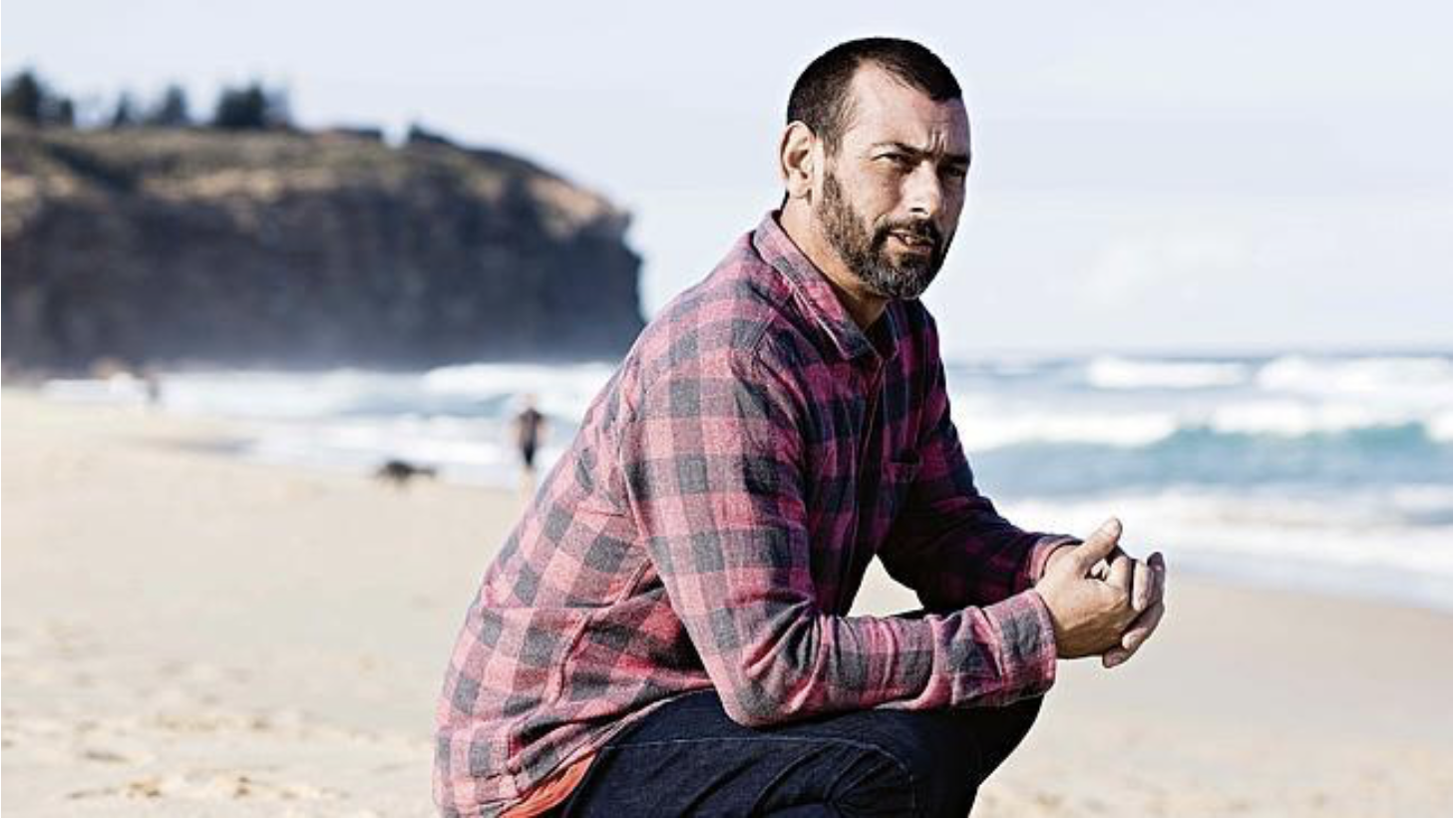
(This story was originally published in The Weekend Australian Magazine on 29 August 2015. Photo courtesy of News Corp.)
He doesn’t see it coming, even in bright sunshine at 4.40pm on a January afternoon. It hits him hard, and at speed. Time stops as he tries to figure out what happened. It must be a boat or a jet ski. But no, it has a rough, rubbery texture. A dolphin? Please, let it be a dolphin. He turns and starts paddling frantically towards a sandbank 20m away. The other surfers ahead of him all do the same, looking back at him as they paddle away. He doesn’t blame them. He keeps paddling but he feels like he might pass out. Then he looks over his shoulder. There’s a long trail of blood — his blood — drifting sideways in the current behind him. In the middle of it, slowly following him, is the fin of a large shark.
Glen Folkard, 48, is recalling this as he sits on a stool in his garage in a southern suburb of Newcastle, NSW, where he’s lived and surfed almost all his life. He subtly carries his weight on his left side. His right thigh is, in places, a thin veneer of grafted skin covering bone. Every day now is a cycle of pain and strong painkillers for the ache in his femur and shredded nerve endings in his leg. The pain comes in waves; it’s never constant. He sometimes forgets to take his meds because his short-term memory is a shambles, caused by either post-traumatic stress disorder or what he calls hyper-vigilance. It’s mid-morning, his best part of the day. The pain usually kicks in around midday, so he’s upbeat right now. Still, his lips tremble and his hands shake as he describes what happened that afternoon at Redhead Beach, Newcastle, more than three years ago.
The shark had grabbed him around his right thigh and buttock, the force momentarily ragdolling him. A shark doesn’t have solid ground on which to thrust itself at its prey. It only has the speed of its attack and the torque it generates from violently twisting its body. This energy is concentrated into its jaws. As it shook its head, its teeth ripped through his flesh and muscle and took chips of bone from his femur, which a surgeon would later come close to amputating. After that initial strike, the shark retreated, Folkard presumes, to recuperate and wait for him to bleed to death.
“This is not gonna be pretty,” he told himself when he saw the shark in his blood stream as he paddled away. There was no life-flashing-before-his-eyes moment, he says; just the sudden realisation that his kids, Cooper, aged two at the time, Grace, nine, and Ellie, 13, might grow up without him.
Then one of the other surfers in the water turned to help. Nathan Visscher got within 5m and saw a silhouette of the shark on a wave, close to Folkard. “It was about the size of five dolphins, and looked like a submarine,” says Visscher, who grew up surfing and spearfishing at this beach; he’d never seen anything like it here before. By the time he got to him Folkard’s eyes were bulging, his face was white, his lips clammy. He was struggling to get back on his board properly. Visscher saw the wound on his leg and wondered if the limb might fall off. “It’s OK mate, it’s just a scratch,” Visscher said.
By now they were surrounded by a dark circle of Folkard’s blood. If the shark was nearby, they couldn’t see it. Visscher pushed Folkard to the sandbank and got him on a wave. Visscher paddled sideways out of the blood and caught the next wave in, meeting Folkard 10m from shore. They caught another wave to the sand, where lifesavers and other surfers were waiting to help. Leg ropes were removed and used as a tourniquet. Folkard was stretchered to the surf club where Visscher, who would receive an Australian Bravery Award for his actions, held his hand and told him everything was going to be OK.
Folkard shut his tattoo shop, unknowingly for the last time, on January 18, 2012. His last client for the day had cancelled, giving him time for a quick surf on the way home. He called his wife, Angela, to ask if he needed to pick up anything on the way. She was putting Cooper to sleep and ignored the call. The thought that that might have been her last chance to ever speak to him still haunts her today.
He didn’t get home until 23 days later, having endured six operations and infections that almost cost him his leg. While in hospital, he was interviewed on radio. Dave Pearson, a surfer who had been attacked by a shark 200km up the coast at Crowdy Head the year before, heard the interview and felt the need to contact Folkard. He’d previously tried to reach out to other, higher-profile attack survivors, but they didn’t respond the way he’d hoped. Some, he discovered, wanted to use their experiences to make money. Fair enough, but that was not Pearson’s objective. When he heard Folkard on the radio, he thought he’d found the kindred spirit he’d been looking for. “He needed someone to talk to,” Pearson says. So did Pearson. He arrived at the hospital planning to leave later that day, at about 3pm. Instead, he stayed till 9pm. “When I left, they [Glen’s family] all felt better, and so did I. It helped us both.”
Recovery is never that simple, though. When he got home, Folkard’s initial reaction was to sit on the lounge, drinking and watching football on TV with a thousand-yard stare. But his mind kept returning to the attack. Folkard hadn’t seen a single shark at Redhead in 40 years. Yet, six hours before his attack, a shark had sidled up alongside a surfskier there. The sighting had been reported to surf lifesavers, but there was no sign on the beach alerting surfers and swimmers to this when he arrived for his post-work surf. There were two lifesavers on duty — one on the beach and one by the surf club building. An old wooden 6m-high shark-spotting tower sat on the rocks in the middle of the beach, no longer in use.
Why were there sharks here now, he wondered. And why at so many other places in Australia as well? Two people were killed by sharks in Australia in the five months after he was released from hospital. “I was a lucky survivor, watching other people die and get their limbs ripped off,” he says now. He gave up drinking and immersed himself in a more effective therapy: investigating the people who protect the sharks.
He and Pearson formed Bite Club, an open group on Facebook, a support network for survivors, friends and family affected by attacks. A lot was being said about the need to protect sharks; they wanted to correct the balance and bring some focus onto the humans being maimed and injured. Soon, people with no connection to shark attacks started dropping comments about the need to protect sharks. It was Folkard and Pearson’s first introduction to the ferocity of the debate to which they had unwittingly become central. The debate would quickly veer into conservation issues, and get heated. Pearson’s response was to close Bite Club to everyone but invited guests. “Bite Club is not about sharks, it’s about people,” he says. It now has 257 members. “We are family and we protect each other like family.”
It’s a family that keeps getting bigger — shark attacks are increasing in Australia. There have been 15 fatalities in Australia since August 2010 and 53 injuries, which is more than triple the annual average for the past 50 years, according to the Australian Shark Attack File, compiled by the Taronga Conservation Society. The figures for the year so far (25 recorded encounters, two fatalities, 15 injuries) compare with the entire year of 2014 (23 encounters, five fatalities and 14 injuries). Shark enthusiasts say the increase is easily explained: it’s not necessarily a case of more sharks, just more people visiting the beach.
The politics of protecting ocean users is complex and varies from state to state. In Queensland, two protection methods are deployed all year at 85 beaches, mostly on the Gold and Sunshine coasts: drum lines (long lines of baited hooks suspended from a buoy and weighted to the ocean floor) and nets (which don’t form a barrier; rather, they trap any large sea creature that swims through them, including dolphins and turtles). In 44 years, there has been only one fatality at a Queensland beach where these protections are in place.
In Western Australia, where there were six fatalities in the 26 months to November 2013, it is more controversial. The government conducted a 13-week trial in January 2014 using drum lines off beaches in Perth and the southwest. Sixty-eight sharks were caught and killed. The WA government wanted to extend the program for the next three summers, but the decision was not its to make. Instead, federal Environment Minister Greg Hunt, after receiving a report from the WA Environmental Protection Agency that recommended against drum lines, kyboshed the idea. WA Premier Colin Barnett said he was disappointed with the decision.
In Folkard’s state, NSW, nets are deployed off beaches in Wollongong, Sydney and Newcastle, but only from September to April. The operator who checks the nets every two days is bound by the conditions of his licence to release any great whites found still alive in his nets, if it is safe to do so, because they are protected.
In northern NSW, where no protection is in place, there have been four fatalities since 2008. This year alone there have been 12 reported shark-related incidents since February, including the death in February of 41-year-old surfer Tadashi Nakahara who was killed near Ballina, 35km south of Byron Bay. The recent spate of shark sightings and beach closures have led to a remarkable change of heart in the region: a meeting of 200 surfers in Ballina this month called almost unanimously for an immediate shark cull. One surfer at the meeting, Rob Wright, said there was even talk of paying a fisherman on the side to do the job if authorities didn’t. “We just want some action, but nobody seems to step forward and lead the way,” he said. “This is where you get locals thinking these animals have been protected, and people are losing friends.”
The government’s initial response to the renewed anxiety in the area has been to devise a $250,000 “shark urgency response” consisting of a tagging and public education campaign.
**********
By shark attack standards, Glen Folkard’s encounter was relatively minor. Despite the pain, he kept his limbs and his life. But the lingering psychological effects are obvious. In the garage where we talk, the walls are lined with the boards Folkard used to ride with the skill and passion of a lifelong devotee. He still thinks of himself as a surfer, and recalls his best waves in vivid detail, his eyes alive with the memory. Bolted centrally on the main wall is the board he was using on the day he was attacked, a semicircular chunk missing from its rail. “It’s staying there — it’ll never come down,” he says. When I call him a week later and propose going surfing, he responds with a gasp. “Surfing gives me the willies,” he says. He had tried it a month earlier, and spent the whole time looking under the right side of his board. “And the missus doesn’t like it either.”
He estimates that he is at 30 per cent of his previous working capacity. Tattooing is out. He can’t sit for long enough, and has trouble concentrating. His disability pension has alleviated the financial pressure, but he still yearns to be useful. His alternative therapy has been to investigate the policies and organisations that have contributed, he says, to the current shark crisis. He wants to make sure survivors and shark attack victims are not forgotten in this heated debate. It’s the indifference that troubles him. He says he is just another forgettable statistic to the researchers and conservationists who fight to protect sharks. “My life means nothing to them. That’s what hurts.”
The Australian Shark Attack File, he says, is too loose with the numbers. It omits people who have disappeared at sea, possibly because of sharks. And it defines anybody who is attacked while in the water fishing — or even collecting scallops, as Damian Johnson was when he was killed in Tasmania in July — as having provoked the shark. It is not allowing the public to make up its own mind about the dangers of entering the water, Folkard says. He has made an occupation of pouncing on academics or bureaucrats who he sees as unnecessarily defending sharks. Combined with his fragile mental state, these confrontations, usually conducted via email or text, quickly become volatile.
In January 2013, Christopher Neff, an academic at the University of Sydney based in Newcastle, and US shark researcher Robert Hueter suggested a new guideline for classifying shark attacks, redefining them as “bites”. “There are few phrases in the Western world that evoke as much emotion or as powerful an image as the words ‘shark’ and ‘attack’,” their report said. The idea of a shark “attack” was outdated and misleading, they said; avoiding the word would “serve the public interest by clarifying the true risk posed by sharks”.
The Sydney Morning Herald wrote a story about it and rang Folkard for a response, which he gave. Folkard then fired off an email to Neff, saying that if he saw him on the street he’d run him down. He regrets sending the email now. “It wasn’t pretty,” he says. “He [Neff] was trying to lessen the trauma of a shark attack. It aggravated me; that’s when I fire up. I go into a post-traumatic state. I look back and go, ‘Did I write that?’ It’s quite upsetting.” The cops were called. “It’s not a good look, in front of your kids, to have the cops come over looking for you,” he says. No charges were laid.
It’s not the only time he’s fired off abusive emails. Vic Peddemors of the Department of Primary Industries and Australian Shark Attack File curator John West have also been the targets of his vitriol. But the heated messages don’t go only one way. Folkard shows me an anonymous text from someone that says: “Suck shit being attacked by a shark, I’ve been a surfer for 10 years never had a problem with sharks, hope ur in pain u little faggot … shame my friends couldn’t finish u off!”
Dave Pearson, who has returned to surfing and is dealing with his own shark trauma in different ways, says Folkard is a warrior for other people. “He does so much research. He finds people, and gets them to join the club. He calls me the leader, but we wouldn’t be where we are without him. Glen’s heart is in the right place. I just hope he finds peace and closure one day.”
There are signs Folkard is making progress. His life may be defined by his attack, but he is deciding how. His nemeses in the shark-research industry aside, he is resolutely positive about most things in life. In the first few weeks after we meet he messages me most mornings after waking, often agitated, at 4am, to tell me how lovely the colour of the sky is at dawn. He describes the pain — “cold electricity shooting around the sharkhole” — and his exhausting inability to sleep, but doesn’t dwell on it. He gets this from his mother Margaret, who raised him and his younger sister Tiffany as a single mum in a Housing Commission house. “We had no money, but my mother taught me there were always people worse off,” he says. “Now, more than ever, I live that. I’m Lotto lucky. That [keeping his leg] was my win.”
Angela says her husband’s wounds have taken much longer to heal than she’d hoped. He gets agitated and worries a lot. But at least she’s not raising the kids alone. “You dream of growing old with somebody and having children,” she says. “That so easily could have not happened.”
As she talks, Glen constantly interrupts, grabbing a thread of conversation and taking it in his own direction. She talks about lifesavers needing a protocol to follow after a sighting; he butts in with an anecdote about sharks swimming near disabled surfers. She says he is always on alert, waiting for something bad to happen; he says there are frightening images behind his eyelids that he can’t erase. She describes the effect his mental condition has had on their social life; he laments that people only ever want to talk to him about sharks. “I can’t have a normal conversation anymore,” he says. Finally, Angela cuts him off. “I’m talking!” she says playfully. “Go and make us a coffee.”
He laughs, gets up and walks past the board with the chunk missing. “Hey, I’m still mobile!” he says, and, stumbling as his mangled leg momentarily gives way, walks into the house.


