


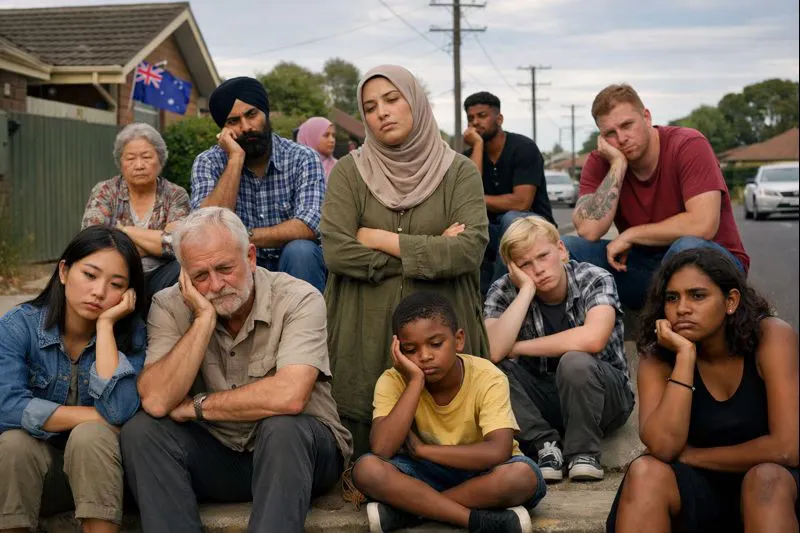
Life without multiculturalism would be “boring”, South Australian Premier Peter Malinauskas told the fourth annual Multicultural Festival in Adelaide in November. “The food would be all the same. If we walked down Rundle Street and went out for a feed, it would be all the same restaurants. I couldn’t think of anything worse.”
I can. And it’s not a street full of burger joints and fish-and-chip shops. It’s being sued for defamation by a woman whose overinflated self-regard is fuelled by the very same “multiculturalism” of which Malinauskas is South Australia’s most enthusiastic advocate.
I’ve never been sued for defamation, but you don’t need much imagination to know that it would be such a prolonged and excruciatingly detailed legalistic examination of a perceived insult that a day spent eating chips and gravy washed down by cans of Fanta would seem positively exciting by comparison.
In a more homogenous society, differences of opinion are either brushed over civilly or settled in the pub car park, as gentlemen have done for centuries. When there is a baseline of cultural commonality, arguments are usually short, and end with, at best, a rapprochement, at worst an agreement to disagree.
But being compelled by someone with whom your share few values or worldly perceptions to dissect the meaning of various supposedly offensive statements to a courtroom while barristers clock up a few hundred bucks an hour for raising objections and legal precedents? I’d rather be force-fed pureed broccoli through a tube up my nose.
This is the rancorous world that Malinauskas both created and supposedly celebrates. It was difficult not to savour the sweet taste of Schadenfreude when I read today that Randa Abdel-Fattah, the Hamas-loving pro-Palestine zealot whose cancellation from Adelaide Writers Week led first to a mass walkout by other writers and then the cancellation of the entire event itself, is threatening to sue Malinauskas for “making a vicious personal attack” against her.
Of course he did. The end product of multiculturalism, after everyone has tasted each other’s cuisine, is an increase in antipathy and misunderstanding between ethnic groups. I won’t dissect what Malinauskas said — not for legal reasons, but because I don’t want to bore you to death — except to say that it was inevitable that Abdel-Fattah or someone like her would take offence at something said during this childishly exaggerated and intractable controversy. Multiculturalism encourages people to isolate themselves in ethnic silos, and not seek common ground. It also incentivises legally recognised but flimsy forms of victimhood, not only through defamation laws but also through “hate speech” laws, of which Australia now has one of the most complex, vague and comprehensive collections in the world.
One of the key aspects of defamation cases is to estimate just how much the defendant’s alleged insult has diminished the plaintiff’s reputation. In the circles I move in, Abdel-Fattah’s reputation could hardly go any lower than it is already, mostly because she has little more than contempt for the country we love, which has provided her with so much freedom and prosperity. It would require something far more offensive than whatever Malinauskas said to reduce her in our estimation. I do concede, though, that there are many people in Australia who see her as both a pitiful victim and an intellectual giant beyond reproach. So if her case ever gets to court, old mate Malinauskas might have a case to answer.
“The music would have no richness and colour,” he went on to tell the multicultural festival in November. “We are so lucky. We are so fortunate to be able to have this here… Over 200 different cultures, languages, colours and creeds, celebrated in our community, done with extraordinary peace and harmony. That is genuinely the envy of not just other parts around the country, but so many communities and corners of the globe.”
You can just picture the ethnically homogenous congregation outside, say, St Stephen’s Basilica in Budapest, Hungary, or a restaurant full of tenth-generation Italian fishermen in Sicily, Italy, gathering around to hear the latest developments in multiculturalism from South Australia and being both perplexed and disappointed by the sudden unravelling of its “extraordinary peace and harmony” under Malinauskas’s watch.
It is ironic that Malinauskas’s federal Labor counterparts are resorting to even more laws to enforce the “peace and harmony” he claims are a natural consequence of multiculturalism.
The new laws the federal government will try to ram through parliament next week have less to do with trying to instil fairness or even equality among the citizenry than they do with legislatively separating us into white Christian oppressors and immigrant oppressed. They will dramatically reduce our ability to discuss the sort of country we want Australia — one of the world’s longest-surviving democracies but paradoxically also one of the world’s youngest cultures — to be.
This is about as fundamental a restriction of free speech as you could imagine, which is exactly how leftists like it.
The other hilariously significant outcome of the brouhaha over Abdel-Fattah’s cancellation from Adelaide Writers Week is that the event itself has now been cancelled. So a bunch of loudmouth, overrated writers objected to one colleague’s cancellation, and now they too are cancelled.
That they consider this a victory worth celebrating tells you all you need to know about where this country is heading.


