


Commentators who predict that the war in Iran will destroy what’s left of the world’s fragile international order often hide behind a caveat.
The “American postwar order will never recover,” says commentator B. Duncan Moench on British website UnHerd, “if Iran’s civilian infrastructure remains intact.” The international laws upon which western leaders rely will be rendered powerless if Tehran is permitted to charge tolls on the Strait of Hormuz, says Tom Sharpe in The Telegraph. It’s a war that “can [not will] bring down the world economy,” warns Jeffrey Sachs on the Judge Napolitano Show.
These caveats reduce supposedly authoritative commentators to a level only slightly above you and me. Better informed they might be, but like us they still wake up every morning and check their phone to see whether Trump’s antics overnight have started World War III or ushered in a beautiful new era of stability devoid of Iran-sponsored terrorism.
In truth, nobody knows if Trump’s mad strategy will work. But at least there’s a possibility it will.
If you’re getting sick of the constant speculation, you’re not alone. One of the best analyses of the war, reflecting what could be a widespread resolution that knowledge about the conflict won’t change a thing anyway, is from American comedian Kyle Dunnigan, who today posted a brilliant song called, I Refuse to Learn About Iran.
We don’t have the same luxury when it comes to the utter carnage being wreaked by domestic politicians. There are no caveats, and ignoring it won’t make it go away. Australia’s decline is both entrenched and irreversible. The current fuel shortages, with the promise of food shortages to follow, are the latest evidence that the nation’s leaders don’t really take their jobs seriously any more.
Neither, sadly, does a vast swath of the citizenry, mostly because they’ve only just arrived in Australia and can barely understand the street signs, let alone pick up the subliminal message in media reports about “youths” killing each other with machetes, businesses “struggling to keep afloat” and the no-worries safety of deadly “vaccines”.
The media maintains the pretence that whatever crises are occurring now will be resolved with the same laidback ease with which we resolved previous crises about overpriced beer and cigarettes. Occasionally this is interrupted with a reminder that, on the contrary, the nation is in treacherous, uncharted waters, and has neither the character nor the cohesion necessary to survive.
“Australia is a nation in decline,” Greg Sheridan warned in The Australian in May 2025. “Across every indicator you can imagine – economy, living standards, social cohesion, crime, health, military capability, the creativity and virtuosity of the arts – we’re in serious decline.”
It was an accurate and alarming piece. Not that Anthony Albanese cared. He was three years away from the next federal election, so any talk of national decline was hardly his problem. Nothing he’s done since then suggests he is aware that he is leading – indeed enabling – a nation in a historic and tragic death spiral.
His preoccupations are those of a man who grew up in social housing and believes there isn’t a problem in the world that can’t be solved with other people’s money. He has followed up his expensively indulgent (and failed) Voice referendum with such critical government projects as spending more taxpayer’s money on “cheaper healthcare”, paying off billions of dollars in student debt, maintaining Labor’s proud history of apologising to Aborigines while throwing billions more at unaudited Aboriginal bureaucracies, blaming Muslim terrorism on the “far right”, flooding the country with unskilled migrants who have no intention of assimilating, and using The Lodge in Canberra as a glamorous backdrop for his second marriage.
If the war has done Albanese any favours, it has been to offer a more newsworthy excuse for his own failures. His trip to Singapore today to secure fuel supplies would not have been necessary if he (or his predecessors from both sides of politics for the past 20 years) had realised the catastrophic consequences of our reluctance to extract any of abundant supplies of oil and gas lying dormant under our continent and offshore, our oil refineries shutting down and our fleet of oil tankers being sold off.
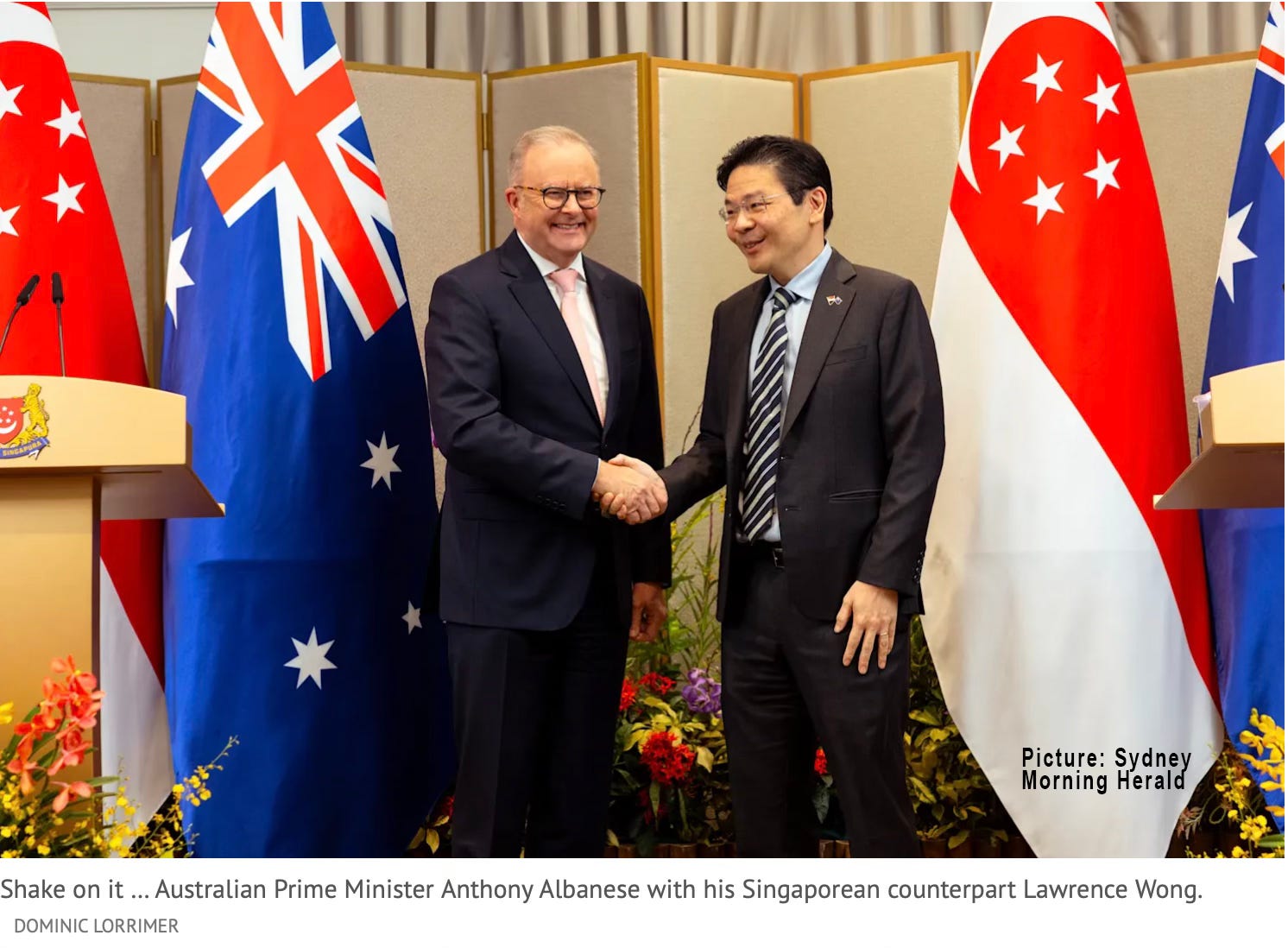
To a distracted punter reading The Sydney Morning Herald or the ABC, Albo’s one-day trip to Singapore looked like a statesman-like mission to call in favours from an old friend at a time of need. In truth, Albo could not be more different from his Singaporean counterpart Lawrence Wong. For one, Wong can speak three languages, one of which is English, and probably needed a bogan interpreter to understand why Albo had suddenly popped by to discuss “d-shell shupply-sh”.
The Herald quoted Albo calling it a “win-win”, which it would have been if Wong hadn’t added a caveat – they seem to be popular in these uncertain times – that he will only provide the fuel that he can spare. Albo may as well have gone to the Lakemba mosque and asked for a ham sandwich and a couple of whiskeys. The look in Wong’s eye as they shook hands suggested he didn’t know why he was being roped into this photo op but was happy to oblige anyway.
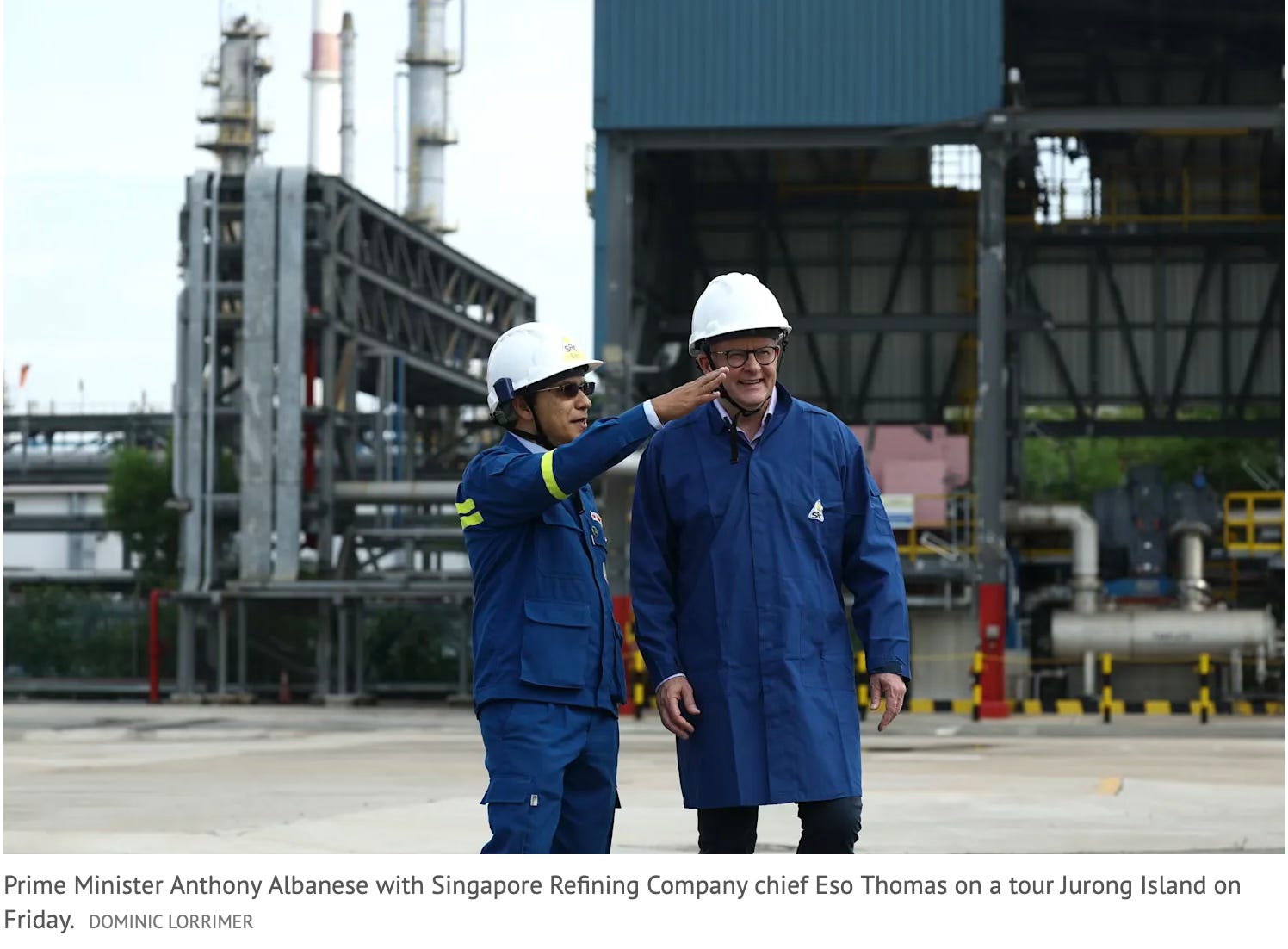
The other photo op Albo enjoyed was to Jurong Island, to visit an actual oil refinery, the sort of thing Australia used to have plenty of back when it was still a serious, modern, industrial, independent country.
This was proof, if any were needed, that Australia is rapidly becoming a Third World nation. In 1963, when Albo was born, the GDP per person in Singapore was just over $US500; Australia’s was four times that, at about $US2000. Now, Singapore’s GDP per person is 41 per cent higher than Australia’s: $US99,000 compared to about $US70,000.
If those figures don’t convince you Australia is screwed, have a look at Albo checking out that refinery. He looks like he’s wondering how they power the place without windmills and solar panels.
The media is mostly going along with the charade that it’s normal for Australia, which is sitting on some of the world’s biggest supplies of oil, gas and uranium, to beg for fuel from a tiny island nation with no natural resources and less than a quarter of its population.
In truth, it’s probably the most embarrassing thing that’s happened to Australia since Malcolm Fraser lost his trousers in Memphis. But it won’t remain so for long; Albo is sure to be even more cringeworthy on his next overseas jaunt, which will be any day now.
And the media thinks Trump is mad.


