


Most commentary about native title in Australia focuses on money and politics — and for good reason. To ordinary people, the amount that traditional Aboriginal corporations receive from mining companies for the inconvenience of having some of their traditional lands dug up is eye-watering.
An investigation by the Financial Review last year found that Aboriginal companies were sitting on more than $1 billion in assets and trust accounts. Disturbingly, these corporations represented only 9 per cent of Aborigines, much to the chagrin, one assumes, of the other 91 per cent. There is “a major gap between those who benefit from native title and those who don’t,” the AFR said.
This explains why the political aspect of the topic also continues to command a certain amount of interest. It’s further proof that our elected leaders are as moronically incompetent as they are ostentatiously compassionate.
It’s now been more than 30 years since federal parliament passed the Native Title Act, under which all these royalties and compensations are legitimised, and the benefits of it all are as unapparent to ordinary Australian taxpayers struggling to survive on a tiny plot of suburban land as they are to the Indigenous mobs sitting around a campfire in the Pilbara wondering where the money went.
These parts of the native title debate are compelling to most Australians because they justify the contempt in which the politicians who created this debacle, and the lawyers and elite Indigenous land owners who profit from it, are held.
But there’s another aspect of all this that deserves equal scrutiny, which at least also allows a moment of wry amusement.
To be granted native title, a group of Indigenous descendants must prove, among other things, that they have continuous connection to the land under their tribe’s laws and customs. Doing this should be more awkward than it is.
The latest claim lodged with the Federal Court, over most of metropolitan Melbourne and thousands of square kilometres around it, for example, is by the Wurundjeri-willam people. As with the descendants of all other Australian tribes, their connection to pre-colonial traditional law and culture is, in the absence of written records and libraries, aural, and therefore vague, to say the least.
But there is one account from the early 19th century of Indigenous law and culture in Victoria that is both written and detailed: The Life and Adventures of William Buckley, published in 1852.
This short book, recounting what escaped convict William Buckley observed as he roamed with the Wallarranga mob west of Port Phillip Bay between 1803 and 1835, contains insights into laws and cultures that modern Australians are surely grateful no longer exist, such as cannibalism, rape, bigamy, the trading of women and savage inter-tribal battles that went on for hours and left small clearings in the bush strewn with blood and corpses.
It’s not the only account of such primitive barbarism. Others, albeit based on secondhand anecdotes, were also published.
It goes without saying, of course, that the people who claim to have a cultural connection to all the land around Melbourne are not proposing a return to these practices.
On the contrary, their cultural heritage is positively idyllic, at least according to the City of Yarra, which has graciously already conceded that the Wurundjeri-willam people are the “true sovereigns” of Fitzroy, Collingwood, Carlton and the other inner-city suburbs under its jurisdiction.
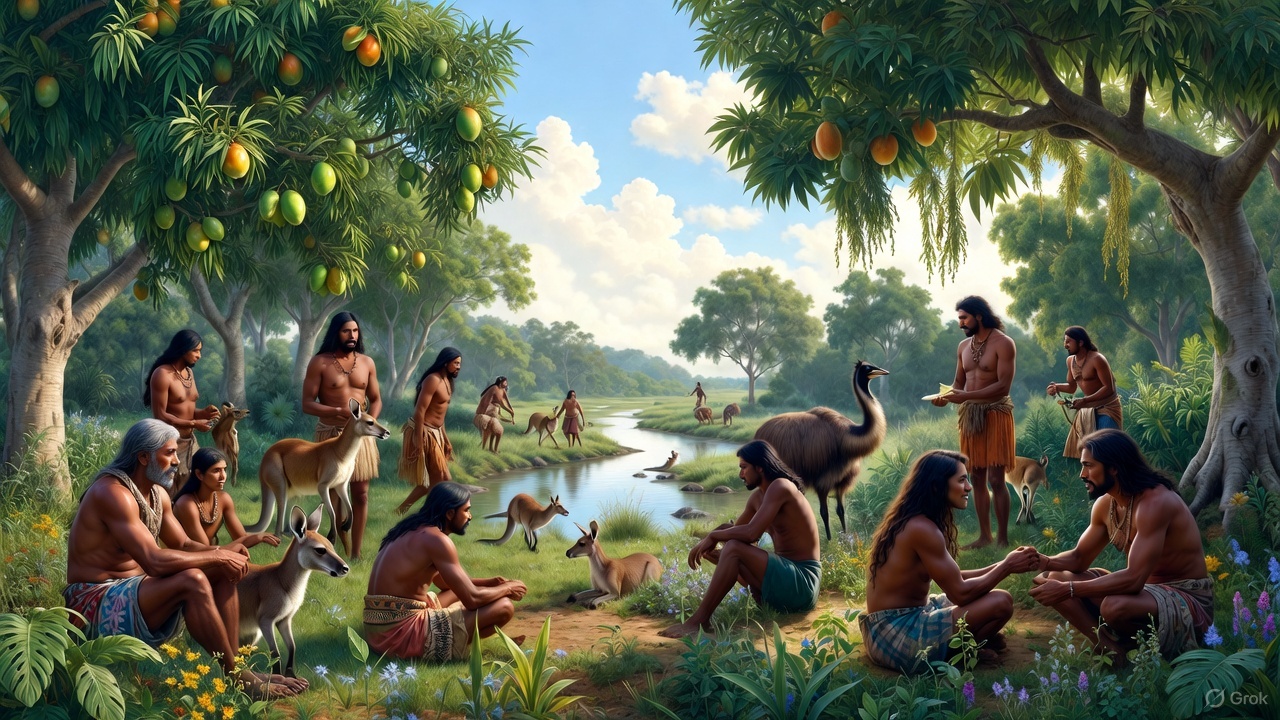
“The Wurundjeri’s connection to land is underpinned by cultural and spiritual values vastly different to those of the Europeans,” a presumably self-loathing council employee of European descent wrote on the council website. “The Wurundjeri did not ‘own’ the land in the European sense of the word, but belonged to, or were ‘owned by’ the land. They did not live in permanent settlements but, rather, camped for periods within defined clan boundaries where food was plentiful, and moved on when the land needed to rejuvenate. The land provided all the Wurundjeri needed – food, water, medicine, shelter – and they treated it with the respect due to such a provider.”
This could hardly be further from what Buckley and others said constituted Indigenous culture before civilisation took hold. It is so far from those contemporary observations, in fact, that one can’t help noticing the white lens through which it is now filtered. It’s more like a hackneyed vision of Jean-Jacques Rousseau’s “noble savages” living in the Garden of Eden, with a subtle hint of 1960s-style naked free love thrown in.
The colour of the skin of the Wurundjeri-willam claimants, which has faded over the years, adds credence to the observation that there isn’t really much about Indigenous culture going on here.
It would be unwise, however, to be too dismissive about this latest claim, nor any others that have been granted or are still in the pipeline. Already 45 per cent of Australia has some sort of native title claim over it, in some cases to the exclusion of white people, as has happened on Ayers Rock and Mount Warning.
The claim over Melbourne comes with assurances that it won’t affect privately owned land. But that won’t stop politicians indulging in new instances of ostentatious compassion and granting co-ownership or managerial rights over public spaces, even in the middle of a city.
Developments on the outskirts of Adelaide have already been disrupted by native title holders, who said in one case: “We’re making sure that what’s happening on our land is culturally appropriate, that you know you’re actually trying to avoid or mitigate any damage or destruction to our cultural heritage.”
That “cultural heritage”, to which they refer with such dubious moral precocity, is more white than they care to admit.


