


On most of the Australian continent, winter is a dull time of year. It doesn’t get cold enough to snow, which would at least be dramatic and interesting; rather, we put up with four or five months wherein outdoor activities are just cold and wet enough to be boringly unpleasant.
But in summer, we come into our own. And this time of year, at the start of summer, as the days get longer and the nights barmier, we are filled with delightful anticipation of what lies ahead — outdoor end-of-year parties, barbecues under the pergola, and of course countless trips to the beach, if not a full couple of weeks in a shack up the coast with the family, which to us is as traditional as mulled wine and roasted chestnuts are on the other side of the Equator.
For some people, however, the summer of 2025-26 will be forever remembered as the year they lost a child, sibling or parent in a shark attack. There were four such families last summer (to which we can add a fifth, which happened in Sydney in winter, a total of 21 fatal attacks around Australia since 2020). We are on track to exceed that grim total this summer because, as everyone knows, the number of sharks are beyond out of control, and the government doesn’t care. Worse, there is a growing consensus that this is a good thing.
A nerd who goes by the name of Drone Shark App captured unprecedented footage of hundreds of sharks off the east coast of Moreton Island (near Brisbane) this month, to which he added a voiceover imbued with almost religious ecstasy. “Oooooh,” he groans with delight, “I’ve never got footage like this before. This is my dream! Look at it!”
Viewers agreed. “How wonderful to see,” one said. “And NO shark nets. Letting nature be nature.”
A mere eight months earlier and 26 kilometres away at Woorim Beach, nature was indeed being nature when 17-year-old Charlize Zmuda was attacked, most likely by a bull shark, and killed.
Zmuda had been a member of the Bribie Island Surf Lifesaving Club from the age of eight. For more than half her tragically short life, she was a member of a club dedicated to voluntarily helping others enjoy a safe day at the beach.
But her admirable life and brutal death are nothing to the shark worshippers who deify nature’s most mysterious (but dumb) killing machine. “She went in the water, she knew the risks,” is their standard dismissive response, which they repeat ad nauseam on social media every time there is an attack.
This summer will be the 11th since I started writing about this topic in The Australian, and the toll has steadily increased ever since. Out of frustration, this year I wrote, produced, financed and edited a documentary about the subject, The Heart of Sharkness, which I published on YouTube in October.
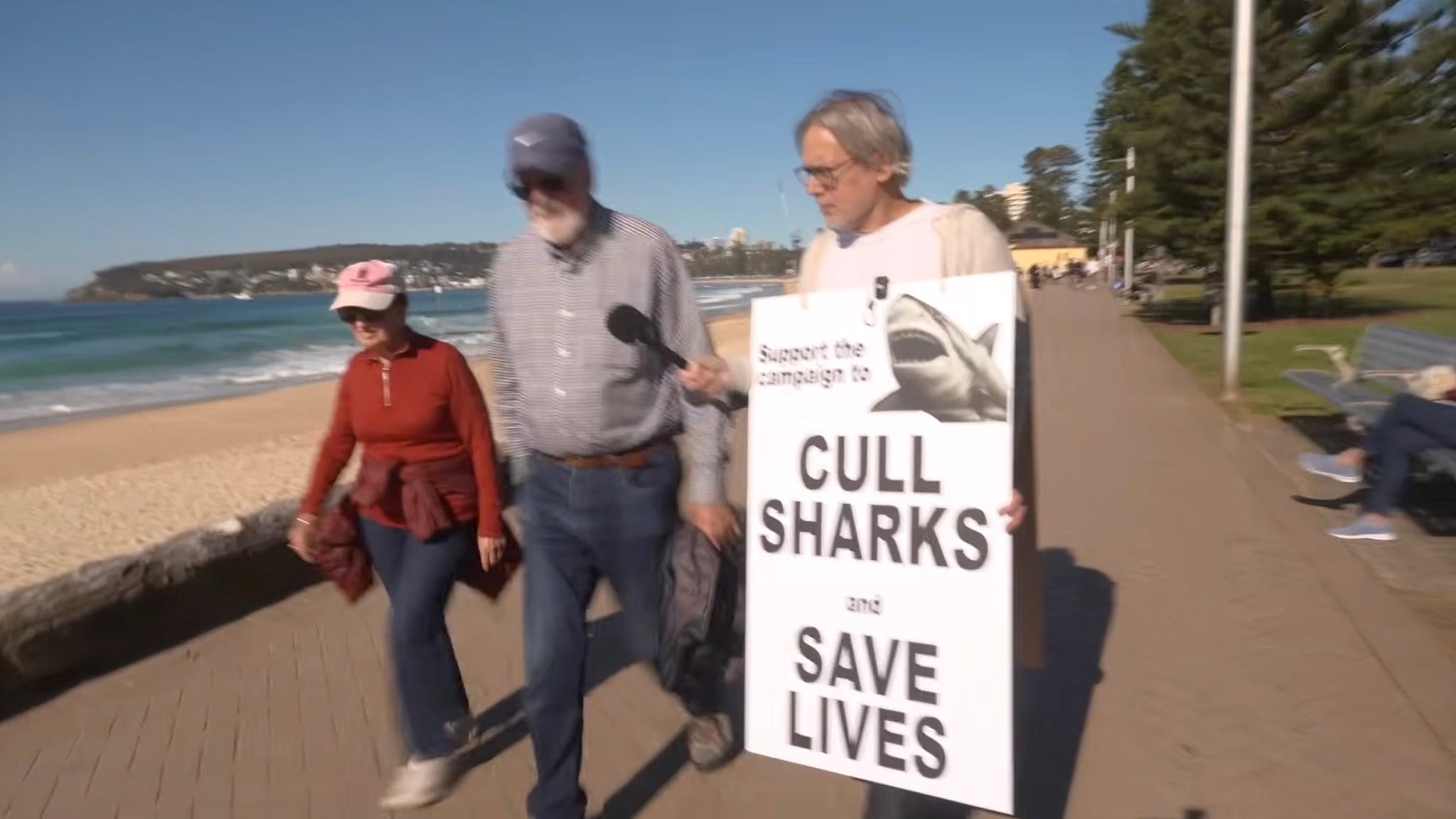
I recommend you watch it if only for the scene at the start where I stroll along the promenade at Manly Beach, Sydney, wearing a sandwich board asking people to “Support the campaign to cull sharks and save lives”.
I was expecting a hostile reaction, and wasn’t disappointed, but the two Karens who yelled at me about misunderstanding the emotional bond sharks have with people — let’s just say, I couldn’t have scripted that if I tried.
Elsewhere in the film I explain that the protection of great whites was introduced in July 2000 on evidence that even the “experts” at the time admitted was flimsy; I talk to fishermen from around the coast who say the size and abundance of sharks are unprecedented; I compare the cheap, effective method of protecting people that has an almost impeccable 89-year record against the expensive, more modern methods now being introduced that seem designed to appease environmentalists, not save human lives; and I get a bit nostalgic about the beach culture Australia is sacrificing on a blood-soaked altar dedicated to dangerous, unpredictable, stupid animals.
I have received enormous gratitude for the film, but also strange resistance.
One demographic you would expect to at least be interested in debating this topic would be surfers. After all, surfers make up the majority of attack victims. But Australia’s two oldest surf publications, Tracks and Surfing World, which in their infancy were bold, creative protagonists of the wonderfully carefree Australian surfing lifestyle, avoided my film like, well, like surfers now avoid Moreton Island.
If this doesn’t epitomise Australia’s new relationship with sharks, I don’t know what does.
If surfers aren’t interested in ending the carnage, you can be sure that the boffins whose careers depend on continued protection aren’t. Nor are politicians. And the mainstream media, which is now perennially paranoid about alienating its dwindling readers and viewers, doesn’t dare challenge this ghoulish consensus either.
The media wasn’t always so timid. In 2016, in the middle of a spate of attacks to which the state government was indifferent, the West Australian newspaper sensationally published a digitally altered image on its front page of some kids splashing in the shore with a large fin coming menacingly towards them, accompanied by the headline, “Will it take this?”
Ten years later, the answer is in. And it’s: no, it won’t.
Two 15-year-old surfers, Mani Hart-Deville and Khai Cowley, were killed by sharks in 2020 and 2023 respectively. And their deaths changed nothing.
The parents, siblings and friends who mourn those kids will hardly be consoled by the fact that more families will also be mourning loved ones before this summer is over.


